

The Assumption of the Blessed Virgin Mary – also known as the Feast of the Assumption – celebrates the belief that Mary was taken up into heaven in her bodily form.
In this understanding, Mary enters heaven with both body and soul through the Christ consciousness embodied by her son. From a contemplative perspective, this can also be seen as a moment of awakening: Mary awakens before death itself, transcending it and entering the fullness of divine unity while still whole in body and spirit.
An Invitation
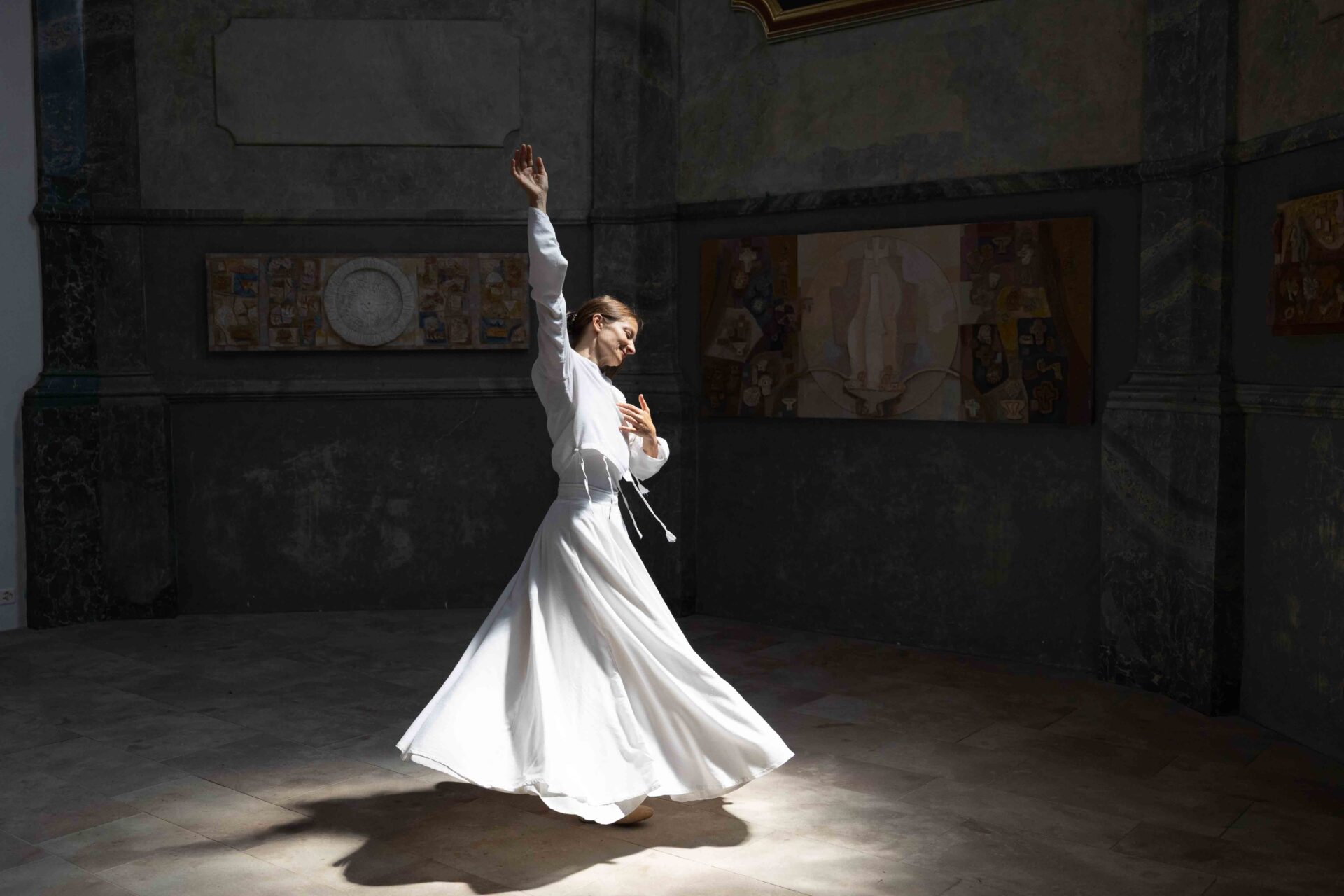
On initiative of the new project ascending, I was invited to contribute a dance prayer to a Catholic service. As a Devadasi – Sanskrit for “servant of God” or temple dancer – this invitation felt deeply meaningful. Perhaps the theme of the Assumption can also be understood as the consecration of the embodied human being: the living body as part of the sacred whole, a vessel through which the Holy Spirit may be expressed.
I felt seen. Recognized. As if I had a task here. For a long time I had felt the impulse to travel to Rome, hoping to receive a blessing – some confirmation from heaven through its earthly representatives, perhaps even a sense of my place in the world. In an unexpected way, this experience felt like an answer to that longing.
The Atmosphere of the Place
Entering the beautiful Verena Minster, where Saint Verena is buried in the crypt, moved me deeply. Within the church one senses both the visible strength of a long-standing institution and something far older and more subtle – a gentle, timeless presence.
Watching the people gather, cross themselves and honor what is sacred to them touched me deeply. Their rituals, when seen more closely, are not so different from those of other spiritual traditions.
Mary – Greatness and Humility
During the service the priest spoke about Mary’s nature: the remarkable way greatness and humility lived side by side within her. Even while aware of her extraordinary role, she referred to herself simply as a servant.
Mary is often called the “Star of the Sea.” She is depicted crowned with the sun, standing on the crescent moon and surrounded by twelve stars – a cosmic mother, a divine mother, mother of existence.
Preparing the Dance
Preparing the choreography was both challenging and deeply fulfilling. I created a three-minute dance to Taizé’s Hallelujah No. 7 without a studio or mirrors. At first I felt overwhelmed.
Only when I surrendered the process and asked for Mary’s blessing did the movements begin to appear. One gesture after another emerged through inner sensing. Mudras – symbolic gestures – formed naturally, expressing qualities I associate with Mary. Slowly a red thread wove itself through the dance.
The Dance Prayer
The inner richness of the dance prayer – the visualization, the devotion, the merging with noble qualities – felt almost more precious than what might be visible to an audience. Yet one member of the congregation later told me that the sincerity of every gesture had been clearly felt.
A particularly powerful moment came during a whirling dance to the Taizé Magnificat. As the music ended, I moved slowly down the central aisle among the people. In that moment I felt an immense force – as if the blessing received in the role of Mary could be carried directly into the community.
Heaven and Earth
The service was filled with beautiful elements: incense, hymns, shared gestures during the Lord’s Prayer, the blessing of herbs, and the joyful presence of the young altar servers.
One small girl repeatedly jumped up, inspired by the dancing and simply wanting to move.
Moments like these reminded me of something very simple and profound: heaven is not only something that awaits us after death. It is accessible even now – here, in the midst of human life. And perhaps each of us has a place prepared within this world.